
Postal traffic (e-Commerce)
Topic description
General
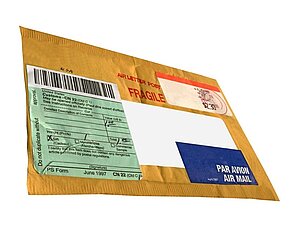
Consignments arriving in postal traffic from third countries (non-EU countries) are subject to customs formalities.
Customs formalities do not need to be completed in cases of consignments arriving in Slovenia from other EU Member States, except for consignments containing goods that have not yet been released for free circulation in the EU or where the consignments have been dispatched from territories that are exempt from the customs territory of the EU or the tax territories of individual Member States.
All consignments arriving from the third countries must be presented to customs. The responsibility for submitting postal consignments lies with the carrier, i.e. the postal operator (e.g. Post of Slovenia) or the express carrier. The data must be submitted with the customs declaration in electronic form. The dataset is prescribed in the customs legislation. The customs declaration is normally lodged by the carrier of the consignment on behalf of the consignee of the consignment. Where the carrier of a consignment is a national postal operator, the rules of the Universal Postal Union shall apply.
The consignee of the goods must provide the customs authority with all the documents and particulars necessary for the customs clearance of the goods for the completion of customs formalities. Where not all the particulars are attached to the consignment, the carrier of the consignment shall request additional explanations from the consignee, which may be related to the additional costs charged by the carrier of the consignment in accordance with his price list for customs services.
Customs duties and VAT are payable on importation.
For low value consignments up to EUR 150 treated as distance sales of goods (e-commerce consignments), from 1st July 2026 special arrangement apples, under which they are subject to temporary customs duty of EUR 3.
Import VAT shall be charged on the taxable amount consisting of the customs value of the goods and the amount of customs duties and other charges payable on importation. Depending on the type of goods, VAT is charged at the general rate of 22 %, lower rate of 9.5 % (e.g. food) or 5 % (e.g. books).
Only indirect representation, in which the representative acts in his own name and on behalf of another person, may be used in the customs clearance of these consignments.
In addition to customs duties and VAT, customs representation costs must be paid when a consignment is imported. Customs agents charge for their services based on price lists, usually published on their websites.
For consignments with a value of more than EUR 150, customs duties shall be charged in accordance with the tariff classification and the rate laid down for that classification.
Generally, a temporary customs duty of EUR 3 is levied by means of a customs declaration per item/product type. The method of payment of VAT depends on whether the consignment is ordered through the special import scheme (IOSS), where VAT is already charged and paid at the time of the order, or whether it is customs cleared through standard procedure, where VAT and custom duties are charged through the customs declaration at the time of the customs clearance procedure.

An example of calculation
A consignment from China bought online containing a pencil, a carnet and a keyring. The package contains three different products which fall under separate items of the customs declaration and will therefore be subject to a customs duty of EUR 3 for each of them, namely customs duty of EUR 9 and value added tax (VAT). VAT shall be calculated based on the value of the goods, including in the taxable amount the value of the customs duties. Where a consignment contains two identical types of goods, e.g. two T-shirts, they shall be classified under one item of the customs declaration subject to customs duty of EUR 3 and VAT.
A customs duty of EUR 3 is charged on one T-shirt with a value of EUR 10. Since the value of the customs duty is included in the taxable amount, the taxable amount is EUR 13. VAT at the rate of 22 % is charged on an amount of EUR 13, which amounts to EUR 2.68. In total, customs duties of EUR 3 and VAT of EUR 2.68 are payable on this T-shirt, giving a total of EUR 5.68.
Relief from import duties
As of 1st July 2026, only goods contained in non-commercial shipments sent by private individuals from a third country to other private individuals in the EU customs territory are exempt from import duties (customs duties) and VAT, provided their value does not exceed 45 EUR. In this context, alcohol, cigarettes and certain other products are subject to quantitative limits. The value of the goods (excluding postage or other indirect costs) shall be taken into account when assessing whether the goods in the consignment qualify for relief.
Return of goods
From 1st July2026, it is no longer possible to invalidate a customs declaration due to the return of goods in distance sales of up to EUR 150, and consequently no possibility of refunding customs duty and VAT on returned goods sold under distance sales of up to EUR 150.
Duty drawbacks are possible under Article 118 UCC for defective goods (e.g. defective goods) or goods not meeting the terms of the contract. Repayment of import duties may be claimed only where the goods received do not correspond to those ordered and have been used only to the extent necessary to establish non-conformity with the goods ordered (e.g. defective goods, goods damaged during transport to the Union, product supplied other than that ordered, product not having the characteristics resulting from the tender).
Detailed description
Legislation
EU legislation
Regulations
- Regulation (EU) No 952/2013 of the European Parliament and of the Council of 9 October 2013 laying down the Union Customs Code
- Commission Delegated Regulation (EU) 2015/2466 of 28 July 2015 supplementing Regulation (EU) No 952/2013 of the European Parliament and of the Council as regards detailed rules concerning certain provisions of the Union Customs Code
- Commission Implementing Regulation (EU) 2015/2447 of 24 November 2015 laying down detailed rules for implementing certain provisions of Regulation (EU) No 952/2013 of the European Parliament and of the Council laying down the Union Customs Code
- COMMISSION DELEGATED REGULATION (EU) 2016/ 341 - of 17 December 2015 - supplementing Regulation (EU) No 952/ 2013 of the European Parliament and of the Council as regards transitional rules for certain provisions of the Union Customs Code where the relevant electronic systems are not yet operational and amending Delegated Regulation (EU) 2015/ 2446
- Council Regulation (EC) No 1186/2009 of 16 November 2009 setting up a Community system of reliefs from customs duty (Codified version)


